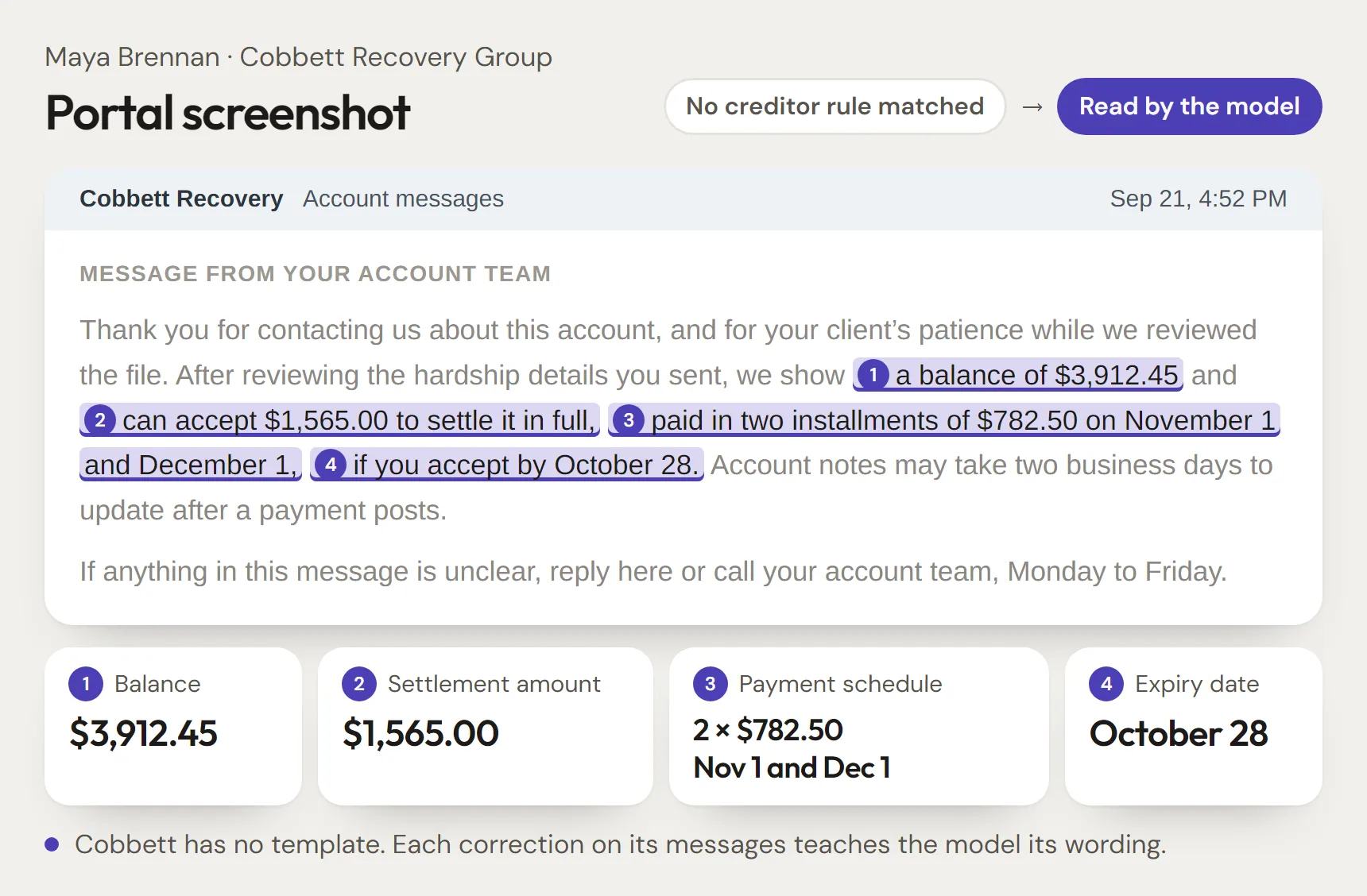
Four proposed fields - balance, settlement amount, payment schedule and expiry date.
Forbear's AI reads creditor mail and writes settlement terms into your existing CRM.
Every figure the AI proposes cites the sentence it came from.
No card. Cancel in a click.
Four vendors will sell you an AI-native CRM this year.
Each demo stalls on nine years of custom fields, creditor mappings and state license logic.
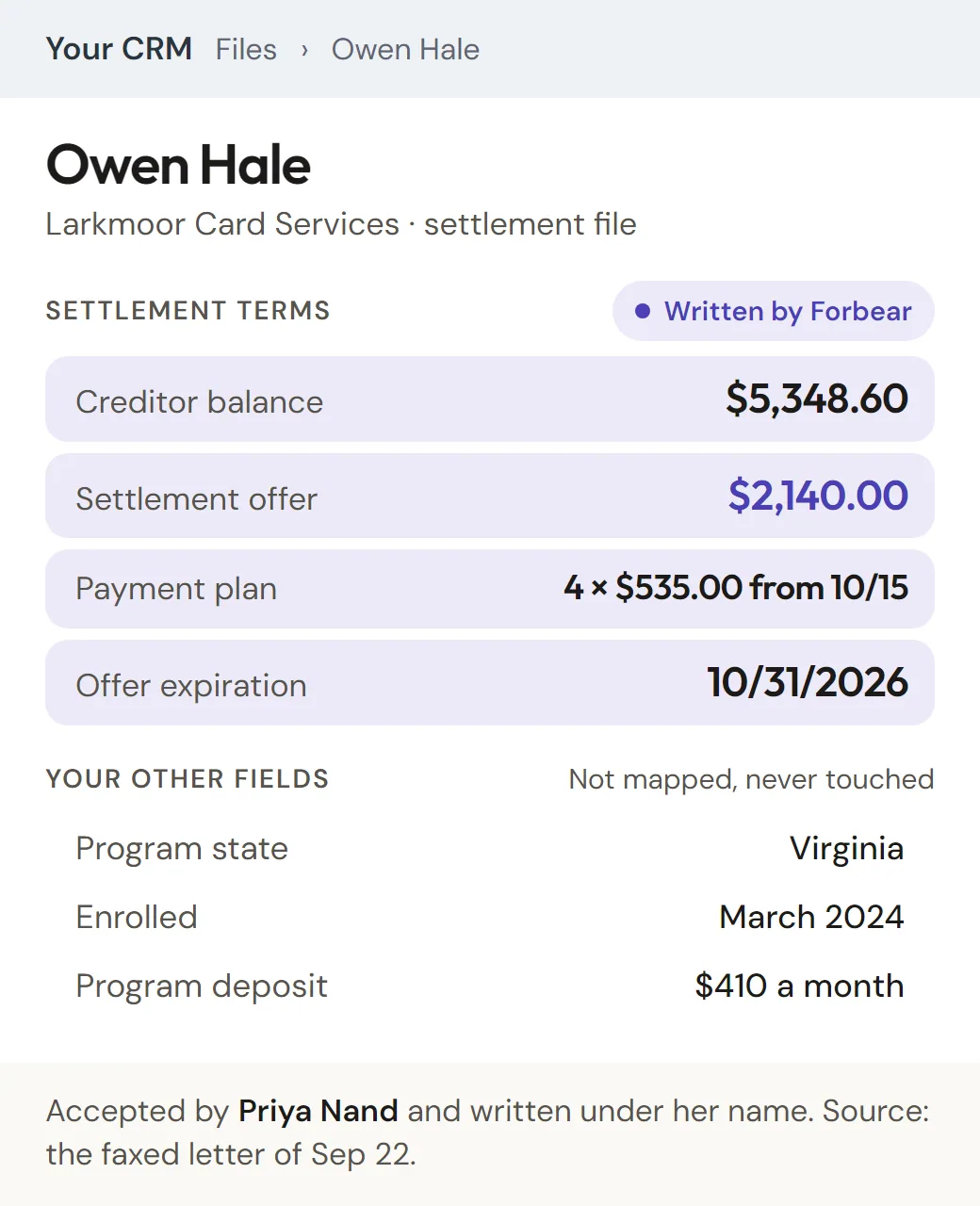
Forbear writes into your CRM, once a negotiator accepts each term.
The AI
The AI that reads what templates can't
A third of creditor mail fits no template: portal screenshots, faxed pages, offers buried mid-paragraph, typed call notes.
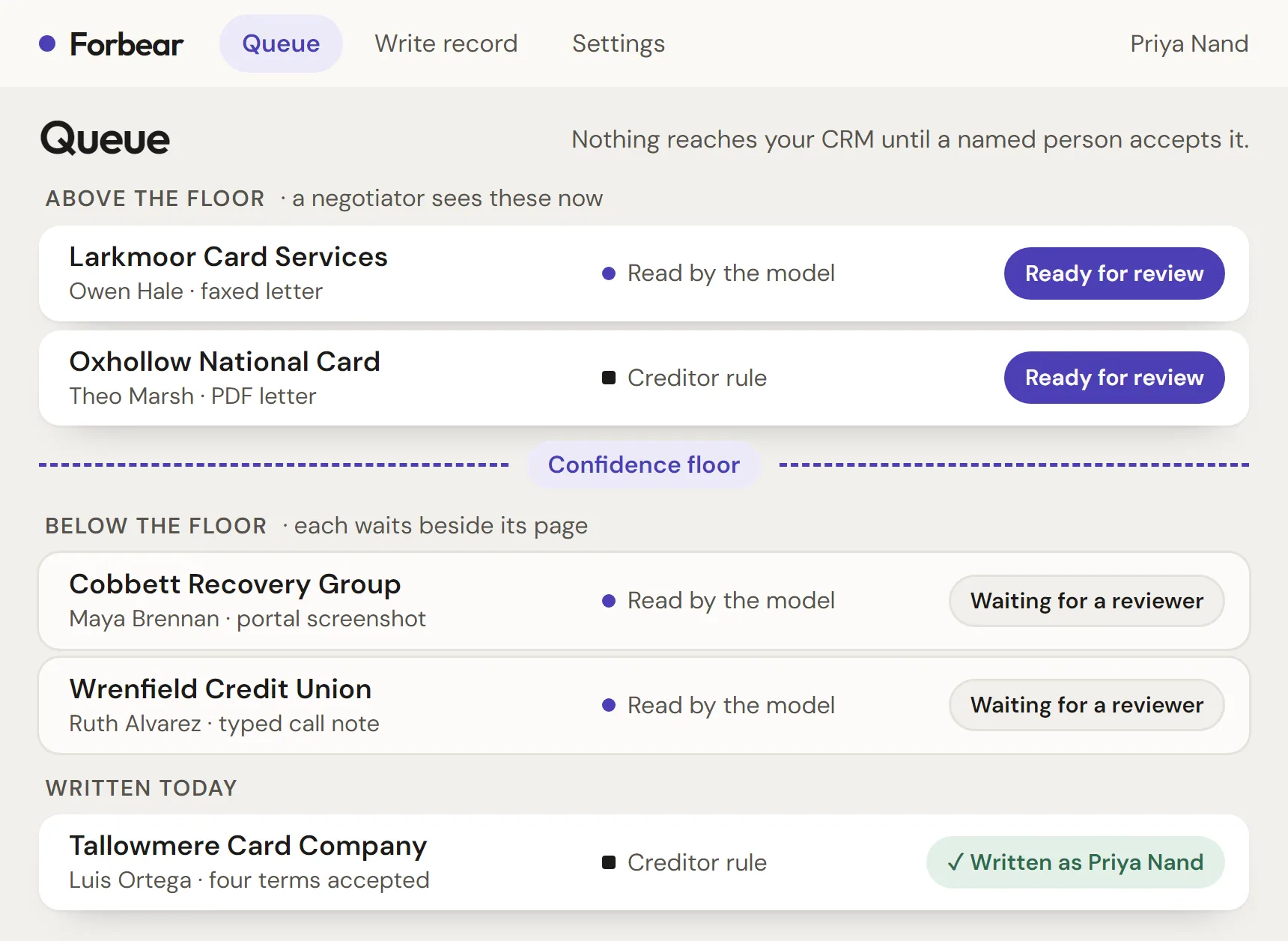
A confidence floor - proposals below it wait in the review queue.
A named negotiator - accepts every figure before it reaches your CRM.
Each acceptance or correction - becomes a labeled pair that trains Forbear's own extractor.
Who it fits
For a firm that will not leave the CRM it already has
If your CRM is six months old and barely configured, just migrate.
This is for you if
- ✓You run 2,000 or more open files in a CRM customised over years.
- ✓Negotiators spend a real share of the day retyping settlement terms.
- ✓You liked an AI-native CRM demo and stopped at the migration.
This is not for you if
- ✕Under a few hundred files, the retyping is an hour a week.
- ✕You want one vendor for sales, servicing and reporting.
- ✕Your creditor correspondence already arrives as structured data.
The call we made
Why Forbear keeps no consumer record
A vendor that owns the record owns the migration, and the migration is why nobody bought.
A nine-year-old CRM survives because its custom fields hold decisions nobody wrote down.
Forbear writes into it and never becomes a second place a consumer exists.
That costs us every buyer who wants one vendor for the whole floor.
How it works
AI extraction, with rules where the format is already predictable
The same steps run on the backfill and on every day's mail.
The model reads the mail - anything no creditor rule matches, in any format.
Rules for fixed layouts - a large creditor's letters need no model call.
Read from your CRM - documents and fields, through its own API.
The review queue - each proposal sits beside the page it came from.
Write back - accepted terms land in your CRM under the reviewer's name.
Connects to
Where Forbear reads and writes
Read on credentials you scope.
- Salesforce
- Debt Pay Pro
- Forth
- CUBS
- Custom REST
- SFTP and email
Scope
What stays with your firm
What's in scope
- 01Nopayment handling, and no access to a trust account.
- 02Nowrite without a named person. An uncleared queue writes nothing.
- 03Noguessed field mapping. You choose every field we write to.
What we don't do
- 01Noconsumer record, pipeline or inbox of our own.
- 02Nocontact with creditors. We never call, negotiate or accept.
- 03Noadvice. An extraction never judges whether a settlement suits a consumer.
Numbers
The same figures at 2,000 files or 14,000
$1,200
per connected CRM per month, flat
- 0234%of incoming documents match no creditor template
- 034fields extracted per document, each with its source sentence
- 0460 secondsfrom a reviewer's acceptance to the value in your CRM
- 057 yearsthe write record is exportable, including after cancellation
Compare
Against the AI-native CRM you were shown
The row that goes against us is the one a floor manager weighs.
CriterionKeeps your existing CRMPrice published before a callOne vendor for the whole floorEach value traced to its documentWorks the week you sign
ForbearYes, it is the only record$1,200/moNo, extraction onlyYes, to the sentenceYes, no migration
An AI-native CRMNo, it replaces itDemo requiredYes, sales to reportingYes, inside their systemAfter the migration
A staffing agencyYesQuoted per seatNoNoYes
Pricing
$1,200per connected CRM, per month
Flat. Any file count, any document volume, any number of reviewers.
- Unlimited documents, files and creditor templates
- Write-back to the fields you map, as the reviewer who accepted
- Exportable write record, kept for seven years
The fee buys extraction and the write record, never seats or storage.
If retyping settlement terms costs your floor over fifteen hours a month, this is cheaper.
Get started
- Free historical backfill of everything your CRM holds, with no document cap
- Billing starts at your first accepted extraction
- Month to month, and every value already written stays yours
FAQ
Questions from the negotiation floor
What if the model misreads a settlement figure?
Nothing, unless a reviewer accepts it.
Where does the AI run?
In East US, on Azure OpenAI and Azure AI Document Intelligence under zero retention; your documents stay in N. Virginia.
What if we migrate to a new CRM later?
Connect it and we write there instead.
Who can accept an extraction?
Only users your firm names.
Connect a CRM and read a year of mail for nothing
A work email starts the backfill.
We reply within one business day.